BALANCE: Enhancing Diversity in News and Opinion Aggregators (2008-2013)
Political information ecosystems profoundly shape people's beliefs, civic participation, and sense of legitimacy toward opposing viewpoints. Much of my early research examined whether online platforms narrow exposure to political diversity — and how interface design, aggregation algorithms, and feedback mechanisms can nudge people toward more balanced information diets.
Designing for "balanced exposure" turns out to be nontrivial. People differ meaningfully in whether they seek out or avoid challenging viewpoints, which means one-size-fits-all interventions can backfire. This body of work — spanning field deployments, controlled experiments, and algorithmic interventions — explores how to measure opinion diversity, how people respond to challenging viewpoints, and how design choices affect satisfaction, exposure, and fragmentation.Understanding how people encounter political viewpoints — and how tools can broaden exposure.
This project was funded by NSF grant #IIS-0916099.
Contributions
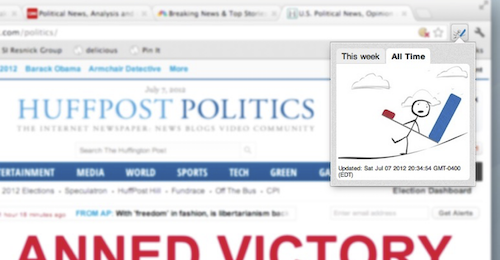
Encouraging Diverse Exposure through Feedback (Field Deployment)
- Deployed a browser extension showing users the political lean of their reading behavior.
- Users receiving feedback made modest but meaningful shifts toward balanced exposure (1–2 more visits to opposing-leaning sites per week, or 5–10 more to centrist sites).
- Demonstrated that small interface cues can influence real-world news consumption patterns.
SA Munson, SY Lee, P Resnick
Algorithmic Interventions to Increase Diversity in Aggregators
- Defines three diversity metrics — inclusion, non-alienation, proportional representation.
- The Sidelines algorithm temporarily suppresses a voter’s preferences to ensure more diverse selection.
- Empirically increased inclusion and proportional representation in test datasets from Digg and political blogs.
- Online experiment: readers were more likely to encounter something that challenged their views in Sidelines-generated sets
SA Munson, DX Zhou, P Resnick
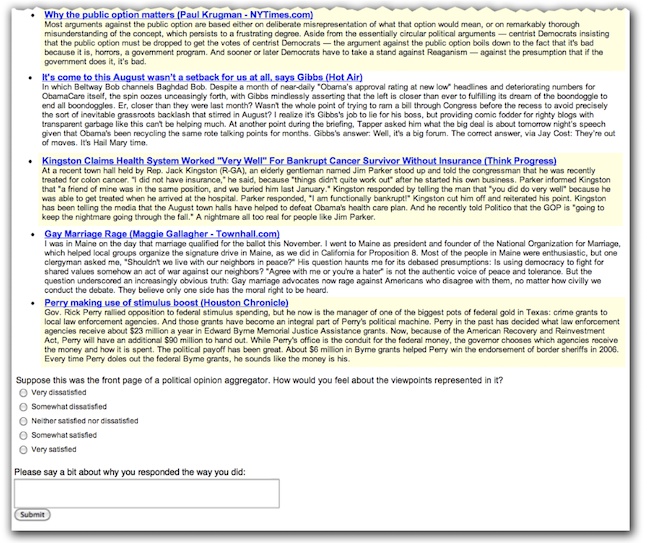
Presentation Techniques and Individual Differences
- Explores reader satisfaction under different mixes of agreeable vs. challenging items.
- Individual differences matter: some readers are diversity‑seeking; others are challenge‑averse.
- Some presentation strategies (e.g., highlighting agreeable content) can backfire by strengthening polarization among challenge‑averse users
SA Munson, P Resnick
Limits of Social Cues
- Tested whether social‑similarity annotations increase interest in political news. Found that most cues (shared city, employer, music tastes, liked organizations, friendship) had no effect on reading interest.
- Identified a backfire effect. Showing a shared job type decreased interest in reading an article, suggesting some similarity cues may reduce engagement.
- Findings reinforce that homophily and preference for agreeable information persist despite social‑based nudges.
E Agapie, SA Munson
Related talks and media
- Exposure to Political Diversity Online, Stanford Seminar on People, Computers, and Design. January 2013.
- Visualization of political blogs' linking.
- News Aggregator of political blogs linking patterns